Discover how a group of determined women teamed up to create a charity that would go on to support thousands of families across the UK.
Twins Trust was born in a suburban front room in Surrey.
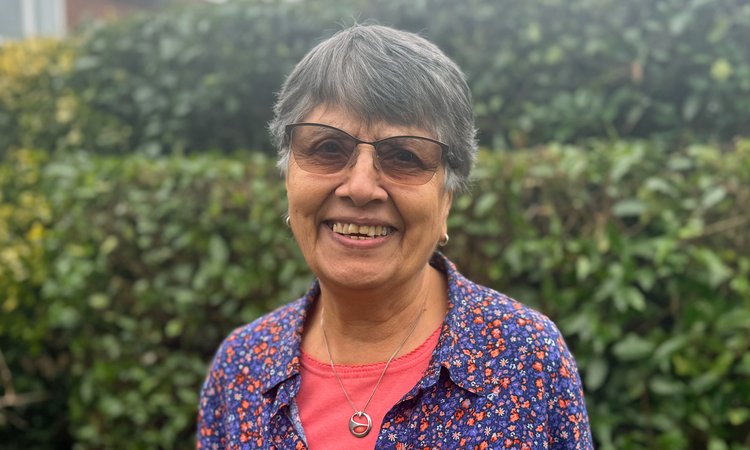
That front room belonged to our President, Ajibha-Judi Linney, known as Judi. She came to the UK from South Africa during the apartheid era. Back home, Judi had passed her university entrance exams, but she was not allowed to attend because of the colour of her skin. Instead, she responded to an advert to come to the UK, where she trained as a nurse and later qualified as a midwife and health visitor.
This is Judi's story of how she became one of the founders of what would eventually become Twins Trust.
"Twins?"
Pregnant and feeling a little uncomfortable, Judi was stunned when she was told at seven-and-a-half months that she was having twins.
She had given up working in London and moved near Woking, Surrey, with her husband, Howard.
"My pregnancy was good and non-eventful until I got to seven-and-a-half months. My feet were starting to swell up and I was very big, so I went into hospital for an X-ray.
"I had one of those hospital gowns on for the X-ray, you know the ones that show your behind! I couldn't even do it up as I was so big.
"There were no routine scans back then and after the X-ray, I remember hearing my husband's voice, then the doctor's voice who was telling Howard (and not me!) that we were having twins. They said that one twin 'did not look very good'.
"I shuffled out of the room with everything on show and just remember saying, in disbelief, 'twins'? I think I was in shock. I started worrying about money and the fact that my family were no longer nearby to help.
"I didn't want to get too excited because I was worried about the second smaller baby. I think I tried to protect myself a bit.
"There were a few sentences in the Bounty book about having twins. But there were no classes, no brochures, very little information on looking after twins. I felt quite alone."
A frightening Valentine's night
Valentine’s night in 1973 was not a romantic one for Judi. With badly swollen legs, she went into labour, still anxious about the smaller twin.
"My first baby, Zareena, was born and weighed a healthy 6lb 1oz. The second, Shareen, was delivered by forceps and weighed 4lb 11oz. Both were taken immediately into special care with no opportunity for me to hold them.
"After a few hours, Howard was at home and got a phone call saying it appeared the twin girls were okay, but that I was very ill. My blood pressure had sky rocketed and I had an eclamptic fit. I was sedated for two to three days, which was upsetting as I didn't see the girls at all and it was frightening for Howard.
"He was left to feed the girls in special care. It was a very procedure-based existence in hospital and we got little attention. Lines of communication were poor.
"I was wheeled in to see them after a few days, but there was no encouragement to touch or hold them... but that's just how it was."
After a week, Judi and Howard went home with Zareena. Shareen followed a couple of weeks later.
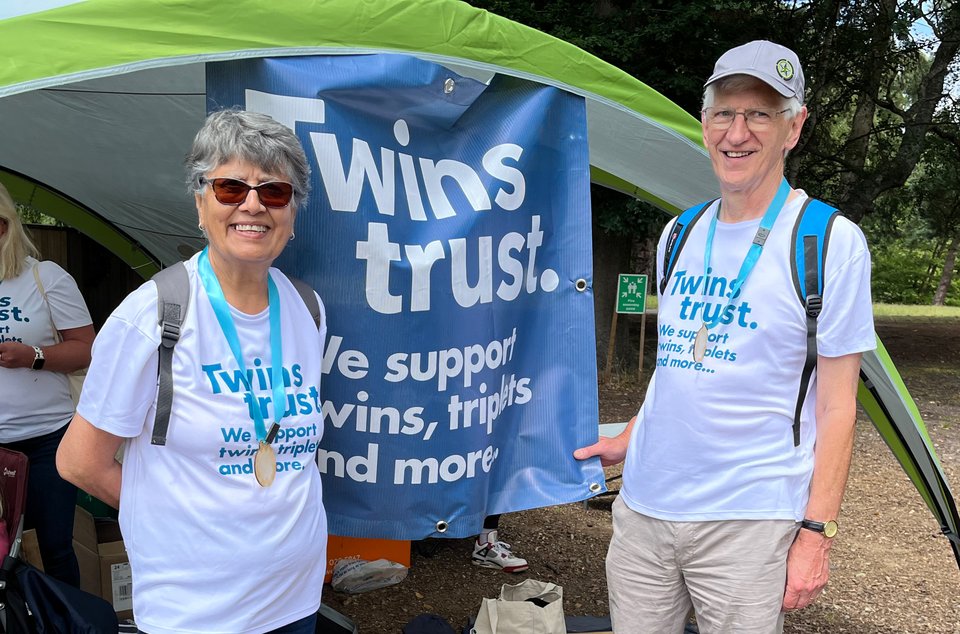
Judi and Howard supporting Twins Trust's Walk for TTTS in 2022.
"No-one I came across had knowledge about caring for twins"
Once the family were home, Judi had a health visitor visit, then had to take the girls to clinics herself.
"After the home visit from a health visitor, it was up to me to take the girls to clinics. I was lucky that I was a health visitor myself, but the service was different then. We worked with everyone, even visiting schools.
"No-one I came across had knowledge about caring for twins, which I suppose is when I felt something needed to be done.
"Those first few months were very isolating. Howard was back at work. There was no social media so I tried to go out when I could, but I was not allowed to take the pram into health clinics or shops, so I always had to have someone with me."
When the girls were four and started school, Judi used a childminder and returned to work part-time. At the same time, she began talking to other health visitors and midwives about what families with twins or triplets needed.
"Everyone agreed there was not enough information about having twins. I started a plan. I tried to find out where there were twins clubs. I did some research in libraries and I wrote letters to various health professionals," Judi said.
The letters that changed everything
One letter, in particular, helped turn Judi's concern into something bigger.
"I wrote to Dr Elizabeth Bryan who had written articles about twins. She was a paediatrician working with twin families in York. She wrote back and wanted to help."
Judi was not alone for long. Other parents with the same determination joined her.
"The other founding members of what was to become the Twins' Clubs Association (later Tamba, then Twins Trust) were twin mums June Tatch and Sue Wright, along with Carola Zentner, a mother of two sets of twins."
In the autumn of 1978, the group held a meeting at the NCT headquarters in London, attended by representatives from around 12 existing twins clubs across the country.
"This was covered by The Guardian and national TV and radio. Over the next few months we were inundated with letters and knew we had to develop a structure."
From late 1978 into 1980, the association gathered pace. Leaflets were produced, networks were built and links were made with around 120 twin clubs. In 1984, the association became a registered charity.
"The rest, as they say, is history."
In 2008, Judi was awarded an MBE for healthcare and the community. She remains at the heart of our charity to this day.
Judi's legacy, and a charity that grew from one front room
Looking back, Judi sees a clear line between her early experience and the charity's purpose today: families deserve information, community and practical support, right from the start.
"I am delighted that we are still working hard to improve the lives of families caring for twins, triplets or more, supporting them through courses, webinars, our helpline and in-home support, whilst remaining committed campaigners to ensure better births and care and investing in research."
From one front room in Surrey to a national charity supporting families across the UK, Judi's story is a reminder of how change often begins: one parent noticing what is missing and deciding to do something about it.
Help us continue Judi's work
We need you to ensure we can continue the work that Judi started and support many more families with twins, triplets or more. Join your community today as a Premium Member.
Published