Key takeaways
Follow the same safe sleep steps for each baby, for every sleep
Keep your babies in a clear, flat, firm sleep space in your room for the first six months
Twins and triplets can share a full-sized cot when they are very young, but need enough space, good airflow and separate sleep spaces once they roll
Co-sleeping is only ever with one baby in an adult bed and never with babies who were early or very small at birth
Safe sleep basics for twins in the early months
Bringing home twins, triplets or more is exciting, emotional and often exhausting. Between feeds, nappies and visitors, it can feel hard to keep up with every bit of advice, especially around sleep.
Safe sleep guidance is designed to reduce the risk of sudden infant death syndrome (SIDS). SIDS is when a baby dies suddenly and unexpectedly in their sleep, with no obvious cause. It’s very rare, but babies who are born prematurely or have a low birth weight are at higher risk. This means many twins, triplets or more fall into a higher risk category, so following simple steps for every sleep really matters.
The aim isn’t to make you anxious. It’s to give you clear, practical information so you can feel more confident about where and how your babies sleep. A simple way to remember the essentials is:
Back to sleep - clear cot - same room
If you keep this in mind for every sleep, day and night, you’re already doing a lot to help keep your babies safe.
Don’t miss what matters
Get Twins Trust news, support updates and practical resources—straight to your inbox.
Everyday safety considerations for your babies’ sleep
The core safe sleep principles are the same whether you have one baby or more.
For every sleep:
Place each baby on their back to sleep, both day and night
Use a firm, flat, waterproof mattress in good condition that fits the cot, crib or Moses basket
Keep the sleep space clear of pillows, cot bumpers, nests, toys and loose bedding
Avoid duvets and pillows for babies under one year old
Where possible, your babies should sleep in the same room as you, both day and night, for around the first six months. This is room-sharing, not bed-sharing, and it helps reduce the risk of SIDS.
Space can be a real challenge when you have more than one baby. You may find they outgrow sharing a cot before you feel ready to move them, or you might struggle to fit multiple cots in your bedroom or living area. There are still safe options. You may need to rearrange furniture or move non-essential items out of your bedroom for a while. For daytime naps, travel cots, smaller cribs or compact cots can work well until around six months, and you might use a mix of these upstairs and downstairs.
If you can’t fit extra sleep spaces where you are during the day, try leaving doors open and checking your babies regularly. A baby monitor can add reassurance, but it shouldn’t replace an adult being nearby while they nap.
Aim for a comfortable room temperature of around 16 - 20 degrees. Avoid placing cots right next to a window or radiator. If this is the only option, keep the window closed or the radiator turned off so your babies don’t get too hot. When you come in from a colder place, unwrap your babies and take off hats so they don’t overheat.
Don’t use rolled up towels or blankets to prop your babies up. You may have seen this in neonatal care, but in hospital your babies were closely monitored. At home, it’s safest to follow standard safe sleep advice unless a medical professional gives you different guidance.
It’s never safe to sleep with your babies on a sofa or armchair. Even a brief doze in this position is very dangerous and greatly increases the risk of accidents and SIDS.
Try not to smoke during pregnancy and don’t let anyone smoke in the same room as your babies. Smoke before and after birth increases the risk of SIDS.
Get more from Twins Trust
Free membership gives you access to additional resources and practical guides.
Co-bedding and co-sleeping with twins safely
Co-bedding means your babies share the same sleep space. Many parents choose this in the early months because it saves space and can be comforting for the babies. The shared space must be large enough for each baby to have their own area to sleep in, with room around them. This isn’t just about comfort. It also helps air to circulate around their faces and bodies and reduces the chance of overheating.
Co-bedding is safest when your babies are in a full-sized cot. Each baby should be placed on their back in the ‘feet to foot’ position, meaning their feet are at the end of the cot. Bedding should be tucked in no higher than shoulder height and kept well away from their faces.
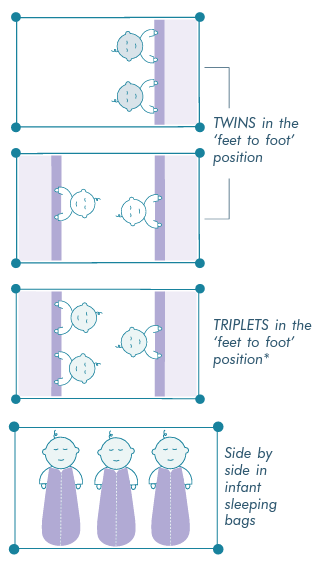
Smaller spaces, such as a single Moses basket, a compact ‘next to me’ style crib or a pram bassinette aren’t recommended for more than one baby. There’s less room for them to move, less air flow and a greater risk of them overheating or covering their faces.
Research suggests that sharing a large cot doesn’t always make babies wake more often and may help them settle into similar sleep patterns. Many multiples who co-bed don’t disturb each other, although every baby is different.
Once your babies start to roll and move around more, they should sleep in separate cots. You may choose to place these close together if you have space, so they can still sense each other while having their own safe sleep space.
Co-sleeping means sharing your bed with your baby. If you choose to do this, only ever share the bed with one baby at a time. Never co-sleep if your baby was born before 37 weeks or weighed under 2.5 kilograms at birth. For these babies, the safest place to sleep is in their own cot or crib right next to your bed.
Keep pillows and duvets away from your baby and make sure they won’t fall out of bed or become trapped between the mattress and the wall. Remember, it’s never safe to sleep with your babies on a sofa or armchair.
Feeling confident about your safe sleep choices
You know your babies and your home best. Safe sleep guidance gives you a strong framework and you can then adapt within that to find what works for your family. When you feel unsure, come back to the basics: back to sleep, clear, flat, firm sleep space, same room as you, smoke-free and not too hot.
If you have questions about SIDS or safe sleep, speak to your midwife, health visitor or GP, or contact Twins Trust or the Lullaby Trust for further support.
With clear information and support, you can feel more confident in the choices you make about your babies’ sleep and focus on what matters most: caring for yourself and your children.
Published