Emma had already been through years of fertility treatment when she became heavily pregnant with her daughter, Ivy. After two rounds of IVF, she and her family were excited to welcome Ivy as a little sister for her older brother. But towards the end of the pregnancy, Ivy’s heart stopped beating and the family was devastated.
Emma has shared her story to help break the taboo around baby loss and grief. She explained: “I’m passionate about people talking about baby loss. In the UK we can be a bit hopeless about talking about grief. As a therapist I don’t usually share my own story, but I feel strongly that sharing our experiences and talking really helps. Hearing the right words or experiencing being really listened to can be a lifeline.”
For Emma, being able to speak honestly about what happened is part of how she honours Ivy, and part of how she hopes other families will feel less alone.
Recognising the hidden weight of fertility loss and hope
Before Ivy, Emma’s path to parenthood had already been challenging. After seven rounds of unsuccessful IVF, she discovered she was pregnant with her eldest son.
Emma said: “I experienced a lot of difficulty conceiving. We had many gruelling rounds of IVF over a number of years and all the disappointments and courage that that entails was exhausting both physically and mentally. A number of the rounds failed and I had a number of miscarriages at different numbers of weeks. Each one was a huge loss as there had been so much hope.”
During those years, Emma sought out support groups and charities to help her cope with the emotional toll of trying to conceive.
She added: “I was incredibly lucky as just as I really felt my body was exhausted and I had no reserves of hope, I became pregnant with my eldest son. After my first born, I became pregnant after two rounds of IVF with my daughter, Ivy. We found that her heart had stopped beating near the end of our pregnancy. I was absolutely devastated. Delivering Ivy was one of the hardest things I’ve ever done. But I was looked after very sensitively.”
Accepting support and allowing grief to change you
In the aftermath of Ivy’s death, Emma and her family were supported by an NHS psychotherapist, who helped them navigate painful decisions, including Ivy’s funeral and other practical realities that can feel impossible to face when you are in shock.
Over time, Emma realised the experience had shifted something fundamental in her. Emma said: “It changed the course of my life. I was working in publishing as an editor at the time. I already loved words, but the transformative power of having your story really heard struck me hard and I retrained to be a counsellor.”
Later, Emma became pregnant again, this time with twins. It brought relief and gratitude, but also fear, shaped by what she had already lived through.
I was a bundle of nerves for the whole pregnancy. When a scan showed I was expecting two boys I was so grateful but also had to accept that I wouldn’t have a girl. Luckily my twin sons are so different that I soon realised that you didn’t need different sexes to experience a huge spectrum of parenting.
During her twin pregnancy, Emma discovered Twins Trust and found support and information that helped her through pregnancy, birth and beyond.
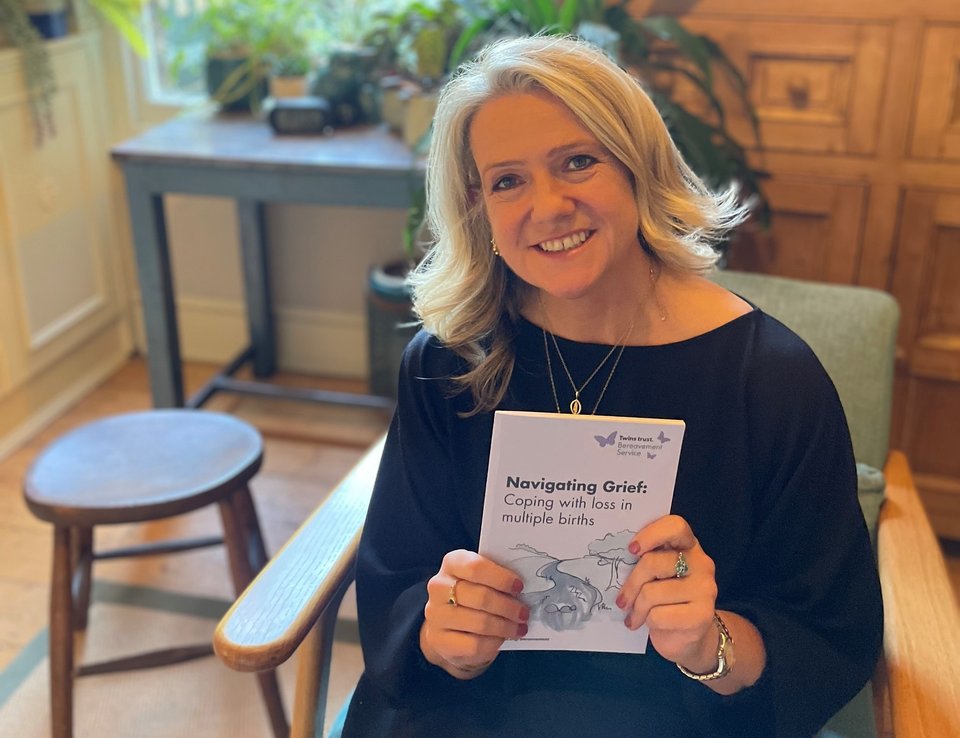
Navigating Grief booklet
The journey through grief can be incredibly difficult. Our Navigating Grief booklet is here to support all parents who have lost a baby or babies.
Turning experience into guidance for other families
When the opportunity arose to work with the charity on a new bereavement booklet, Emma knew she could bring both personal understanding and professional insight. Navigating Grief: Coping with loss in multiple births, created by the Twins Trust Bereavement Service, offers support to parents who have lost a baby or babies from a multiple pregnancy.
Emma said: “Writing the grief booklet allowed me to draw on my personal experience of what was helpful and what wasn't, my knowledge of psychotherapeutic theory and the hundreds of fertility loss stories my clients have been generous enough to share with me. I’ve spent the last 20 years reading every article about fertility, multiples and baby loss that I could lay my hands on. Whether that was policy, medical advances, interventions or personal stories. Writing the booklet was an amazing chance to draw all these things together. My hope is that this booklet will be a doorway to getting the support that’s needed at what is often the one of the most challenging times in people’s lives.”