In 2015, Dr Lynn Cherkas carried out a study on behalf of Twins Trust. The research looked at how families and adult twins felt about classroom placement.
It explored how schools decide placements for twins. It also looked at whether schools used blanket policies, whether families were involved in decisions and how people felt about the outcomes.
Findings from the parents’ survey
In this parent survey sample, around one-third were identical (MZ) twins and two-thirds were non-identical (DZ) twins. This reflects the wider twin population.
The survey included twins across a wide age range. For the school placement questions, only families whose twins had been through placement shared feedback.
This included one quarter of the 746 respondents who had completed the school admissions process and were waiting for their children to start Reception.
Twin relationship
Families generally felt their twins had a close relationship. They also reported that their twins became less dependent on each other after starting school.
There were some differences between identical and non-identical twins. Families of identical twins were more likely to say their twins had a close relationship, were extremely or very dependent on each other before and after starting school, had an equal relationship and were extremely or very competitive.
Where a dominant twin was reported, it was slightly more likely to be the first-born twin.
Join now to keep up to date
Get our latest news, support updates and practical resources straight to your inbox - join as a Free or Premium Member today and opt-in to receive email updates.
School policies
Many families found it difficult to get clear information about school policies. A total of 44% said they were unable to find out whether any schools they were considering had a ‘twin policy’.
When a school did have a ‘twin policy’, it wasn’t always discussed during the school visit. In most schools (81%), families said the policy was only verbal. Only 4% said it was always written down.
In some cases, schools had only one class entry, so twins had to stay together. This applied in two in five cases.
Where schools had more than one class, families said the most common reason for keeping twins together was to help them settle in. Where schools separated twins, the most common reasons were encouraging independence and individuality, helping them build their own friendship groups and avoiding competition and comparison.
Many families said schools discussed twin placement with them. However, some reported that schools had a strict policy.
One in five families said they were told to look elsewhere if they didn’t agree with the school’s policy on twin placement.
Class placement preferences
When asked about preferred placement, just over half wanted their twins in the same class. A further quarter hadn’t decided yet.
Around 10% preferred their twins to be in different classes. None of the twins in this survey attended separate schools.
The most important factors when choosing a school were how close it was to home, the school’s reputation and where older siblings attended primary school.
Most families received the class placement they wanted.
Around one in 10 said they had to compromise. This included twins being separated when families wanted them together, twins being kept together when families wanted them separated, or families travelling further so placement matched their wishes.
Two-thirds of schools discussed class placement with families. In those cases, around 60% chose to keep twins together and 40% chose to separate them.
When families weren’t consulted, schools were more likely to separate twins. In those cases, around two-thirds were separated and one-third were kept together.
Families also reported mixed experiences of flexibility. Around half of schools with a policy offered flexibility and half didn’t. Most of these schools didn’t offer a trial period before confirming the decision.
Families were clear about what they wanted. They wanted schools to consult them about twin placement instead of relying on a blanket policy.
Keeping twins together
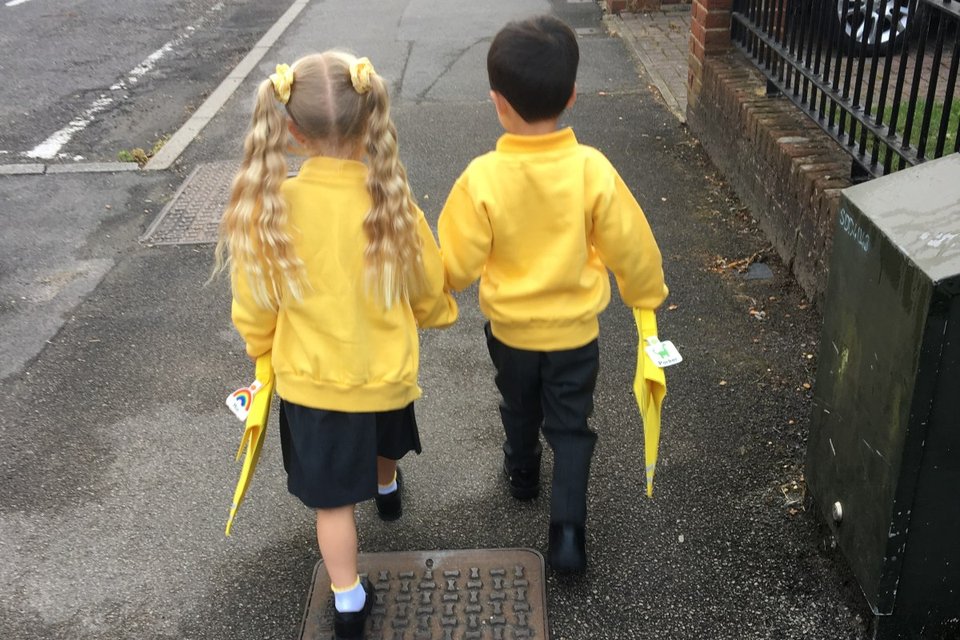
Families who kept their twins together from the start gave several reasons. They often said it made the transition to school easier, gave both children support, and reduced worries about separation at that stage.
Some also said they had no concerns about co-dependency and were happy for their children to stay together. Others felt it was a helpful starting point that could be reviewed later.
Practical reasons also mattered. Families mentioned having one teacher, the same homework and shared events or trips.
Almost all families who kept their twins together felt extremely or very happy with their decision (95%). Most also felt extremely or very confident (91%).
A smaller proportion said they felt anxious (22%) or stressed (11%).
Some later chose to separate their twins. Reasons included concerns about competition, dominance, over-reliance or comparison. Other reasons included supporting independence, teachers finding it hard to tell them apart, the twins wanting different classes, or it feeling like the right time.
Separating twins
Families who separated their twins from the start usually said they wanted to support independence and individuality.
They often wanted to reduce comparison, support separate friendships and avoid one twin dominating the other. In some families, one twin was more dependent on the other.
More than half of families who separated their twins felt extremely or very happy (60%) and confident (53%). These figures were lower than for families who kept twins together.
A larger proportion said they felt anxious (51%) and stressed (41%).
Families reported that around 60% of twins were happy with the decision. In other families, one or both twins were unhappy. Even so, only one in 10 said separation was extremely or very difficult.
After separation, families often reported positive changes. They said one or both twins became more confident, more independent and more outgoing, with higher self-esteem.
A smaller proportion, between 8% and 19%, reported challenges after separation. These included increased anxiety, isolation, mood changes and sleep problems in one or both twins.
Most twins who were separated stayed in different classes throughout primary school.
A small number later moved into the same class. Families said this happened because the twins were unhappy, they were placed in the same ability groups, they wanted to be together, they preferred one teacher, it made things easier for family life, or later year groups had only one class entry.
Get more from Twins Trust
Free membership gives you access to additional resources and practical guides
Adult twins survey
The adult twin sample included more identical twins than non-identical twins. Around 70% were identical. This reflected the registry used to recruit participants.
Half of respondents were aged 16 to 40 and half were aged 41 to 50.
Among those who attended a school with more than one class, around two-thirds were kept together and one-third were separated.
Around one-third of those who were placed together at first were moved into separate classes later.
Being kept together
Adult twins who were kept together usually felt this had no effect on their twin relationship. Around one-third felt it brought them closer.
Non-identical twins were more likely than identical twins to report a negative effect on the relationship. Around one in 10 non-identical twins said they felt less close as a result.
Many twins (38%) said being in the same class had no effect on self-confidence. Similar numbers said it increased self-confidence (29%) or reduced self-confidence (22%).
Three-quarters of twins were very or fairly happy that they were placed in the same class. This was more common in identical twins than non-identical twins.
Some twins were later separated because of concerns about individuality, confidence and independence.
Being separated
Twins who were separated, either at the start or later in school, described a wide range of feelings.
Some were happy, adapted well and enjoyed the experience. Others felt upset, scared, confused or lonely.
Most now feel positive about the decision in hindsight, although some still feel it was the wrong decision.
Just over half (54%) said they didn’t find separation difficult. A total of 16% said it was very or extremely difficult.
Most twins didn’t report problems with eating, sleep or stress after separation.
Two-thirds said separation had no effect on their twin relationship. Only 16% said they felt less close. However, separated twins were less likely to say the experience brought them closer than twins who stayed together.
Twins who were separated were more than twice as likely to say separation increased self-confidence than decreased it. They were also more likely to report increased self-confidence than twins who were kept together.
More than half (54%) were very or fairly happy that they were in different classes. Around one-third felt neither happy nor unhappy.
Twins who were kept together were happier with the decision overall.
A small proportion of twins who were separated were later placed together. This was often linked to emotional difficulties or an effect on school work or grades. Most were happy with the later decision.
Friendship and adulthood
Friendship patterns varied by twin type. A total of 36% of identical twins and 20% of non-identical twins said they shared all the same friends.
During primary school, half of respondents felt there was a dominant twin in the relationship. This was more common in non-identical twins. By adulthood, this had fallen to 39%.
Three-quarters of twins felt they were very or extremely close in childhood. A similar proportion felt the same in adulthood. This was more likely among identical twins.
Adult twins had mixed views on what schools should do. A quarter felt schools should always keep twins together, around one-third felt twins should be separated and around two-fifths said it depends on other factors.
Reasons for separation included being treated as individuals, having separate friends, being better prepared for separation later, developing confidence and individuality, and avoiding comparison.
Reasons for keeping twins together included supporting the twin bond, allowing confidence and individuality to develop through good teaching rather than forced separation, and reducing anxiety about being separated.
For those who said ‘it depends’, key factors included how close the twins are, whether twins or families can choose, the individual needs of each twin and the wider relationship dynamics.
Study findings
This research shows there isn’t a single approach that works for every family.
Families and adult twins reported a wide range of experiences. The strongest message was the need for discussion, flexibility and decisions based on each twin pair’s needs rather than a blanket policy.
See the full survey results
-
Survey results of parents of young twins regarding placement of twins in primary school
Download PDF (1.6 MB) -
Survey results of adult twins regarding their experiences as a twin at primary school
Download PDF (625.0 KB)
Published